 starduststorm
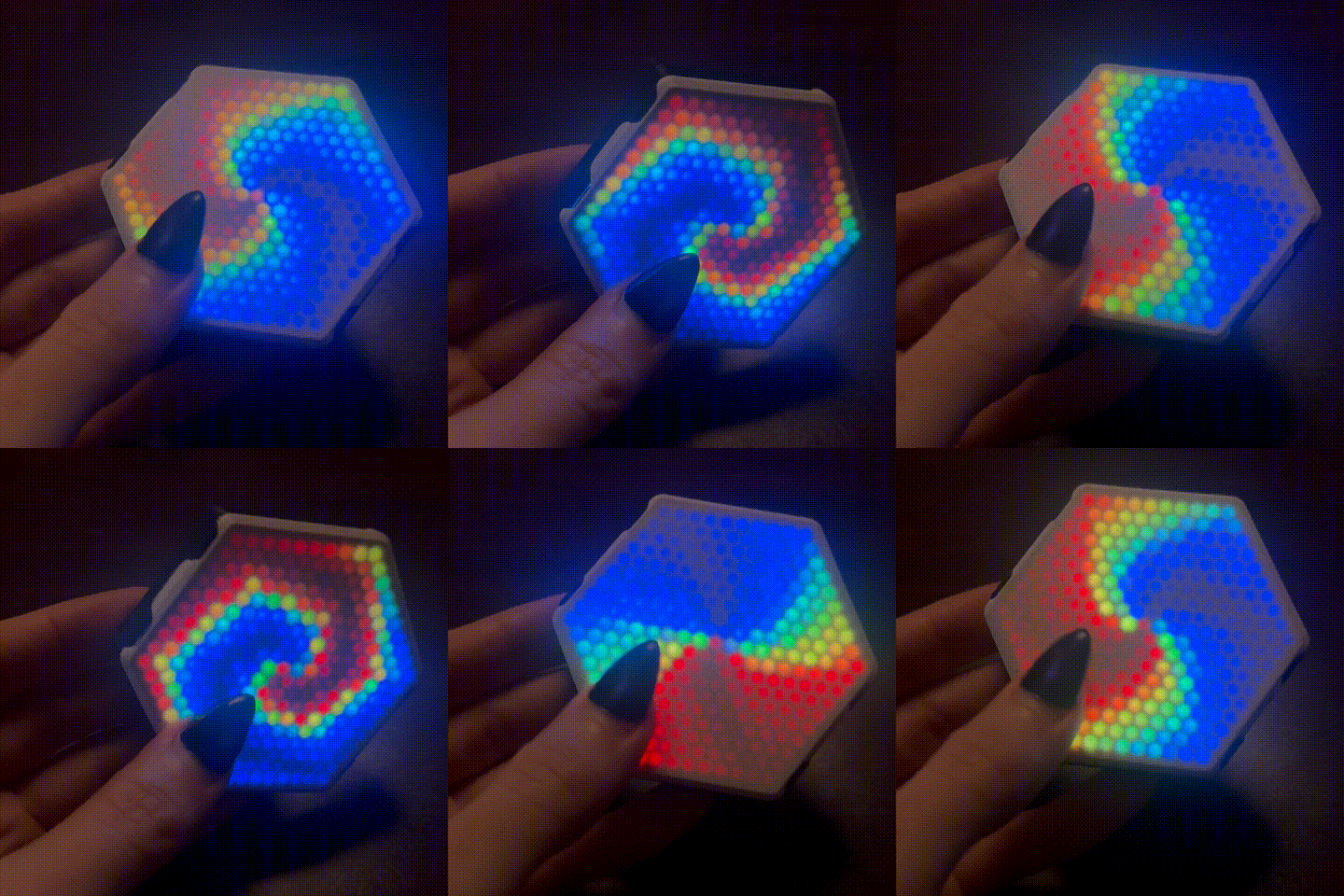
motionhexa is a hand-held, glowy stim-toy, incorporating buttery-smooth motion responsiveness, particle physics, and music waveform visualization into a familiar six-sided shape.
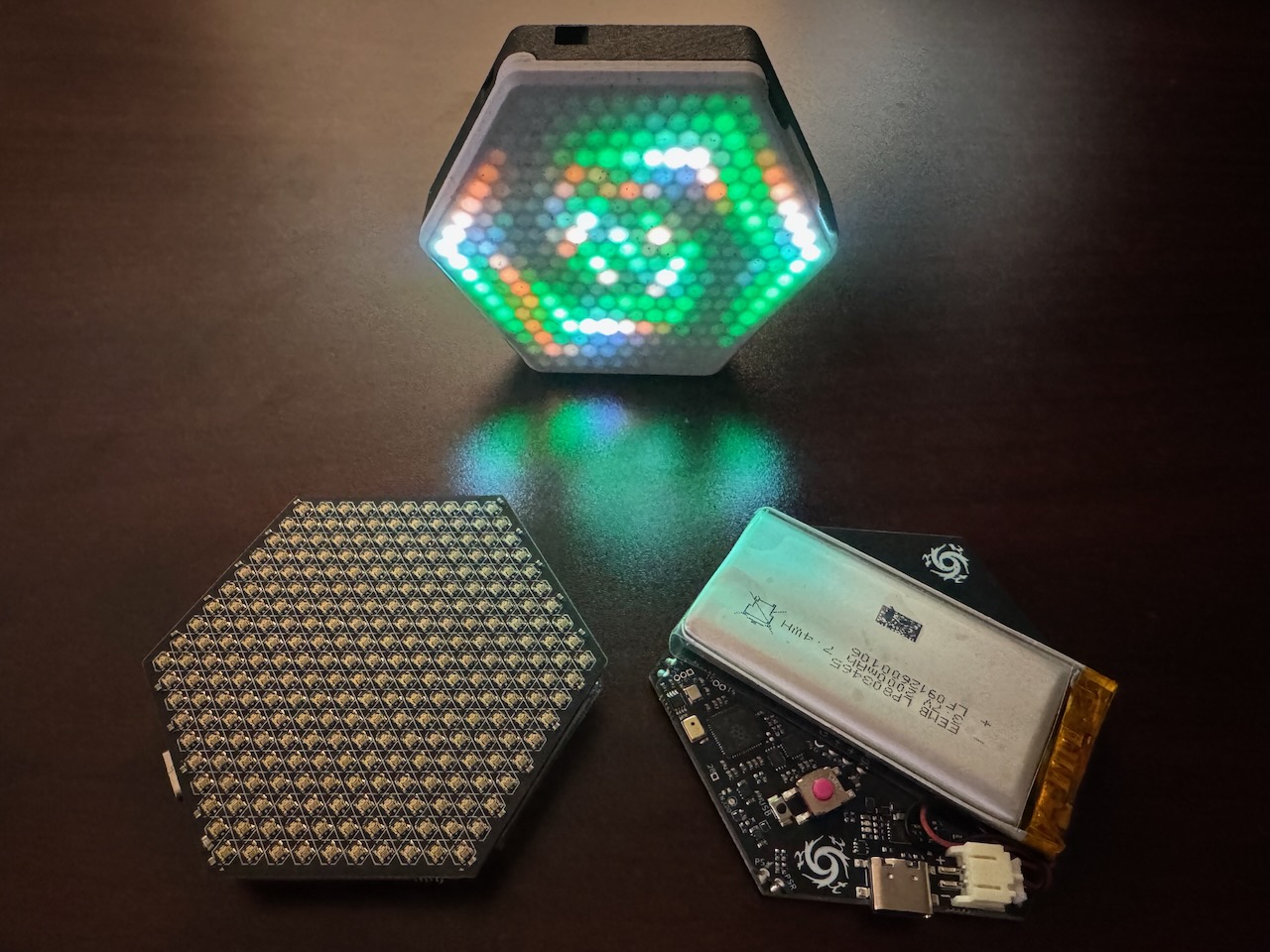
The pixels pcb has 271 pixels in hexagonal lattice. The controller is a wedge-shaped pcb with a dual core processor, an inertial motion unit, a microphone, and battery management hardware. A large 2000mAh battery takes up most of the space, giving the hexagon 9+ hours of battery life.
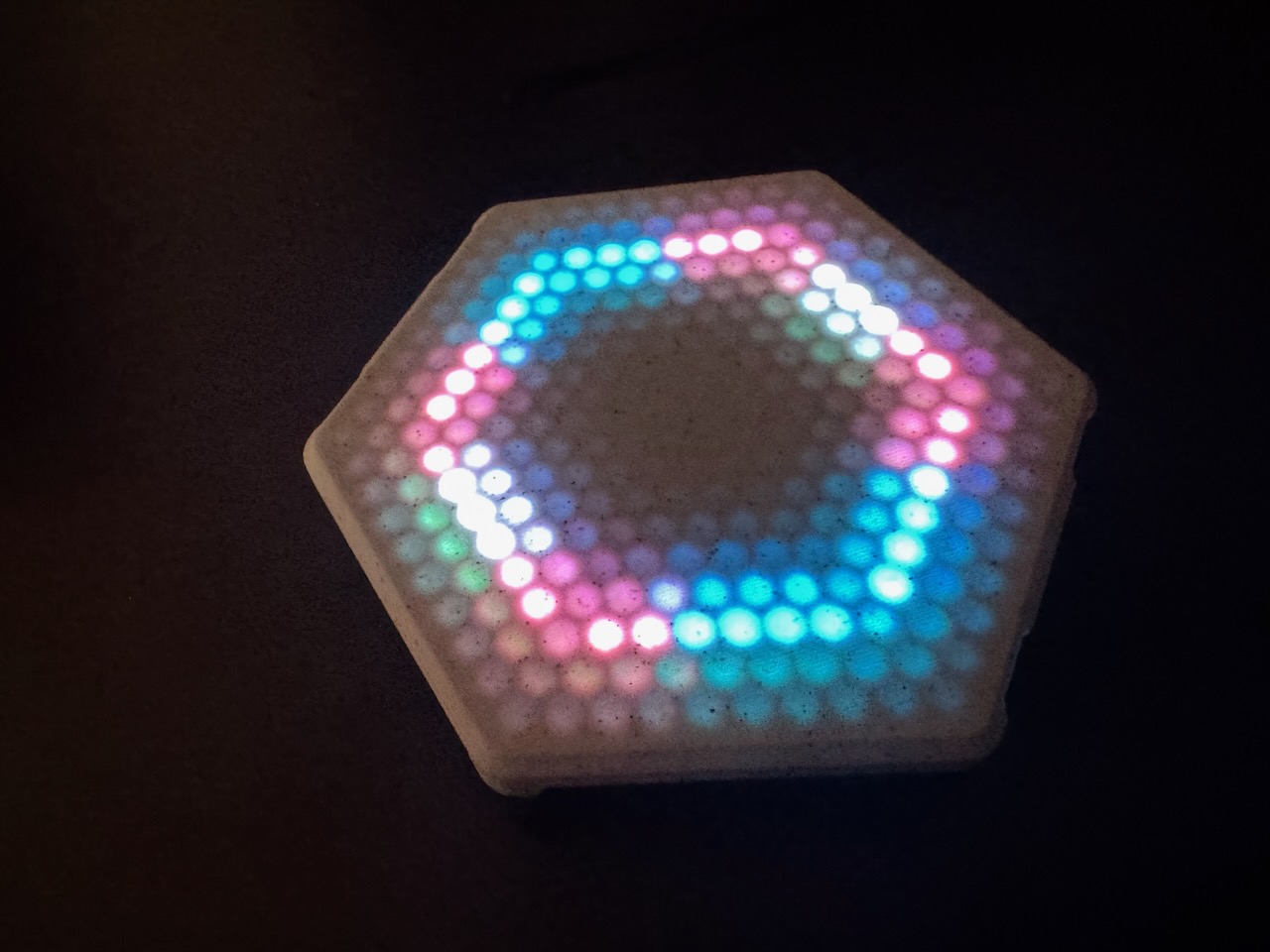
motionhexa started as a learning project. I wanted to make more advanced wearables, but i needed to learn how to put motion chips on pcbs, and i also wanted to play with a hexagonal pixel arrangement. My previous wearables had also been dependent on store-bought USB batteries while i vexed on the circuity needed for the integrated lipo charge + 5V DC boost chips i was finding, so i decided to tackle that for hexa.
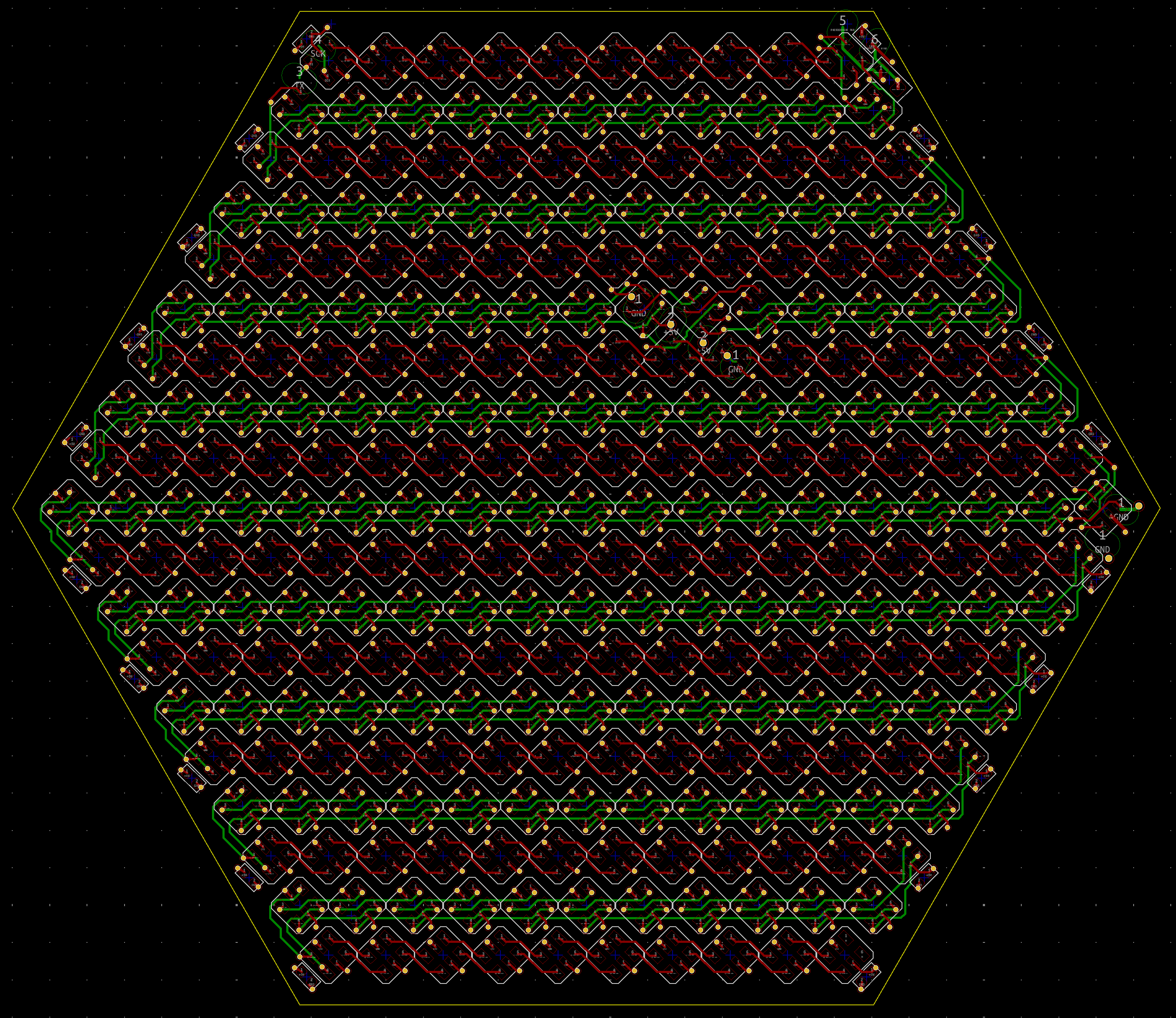
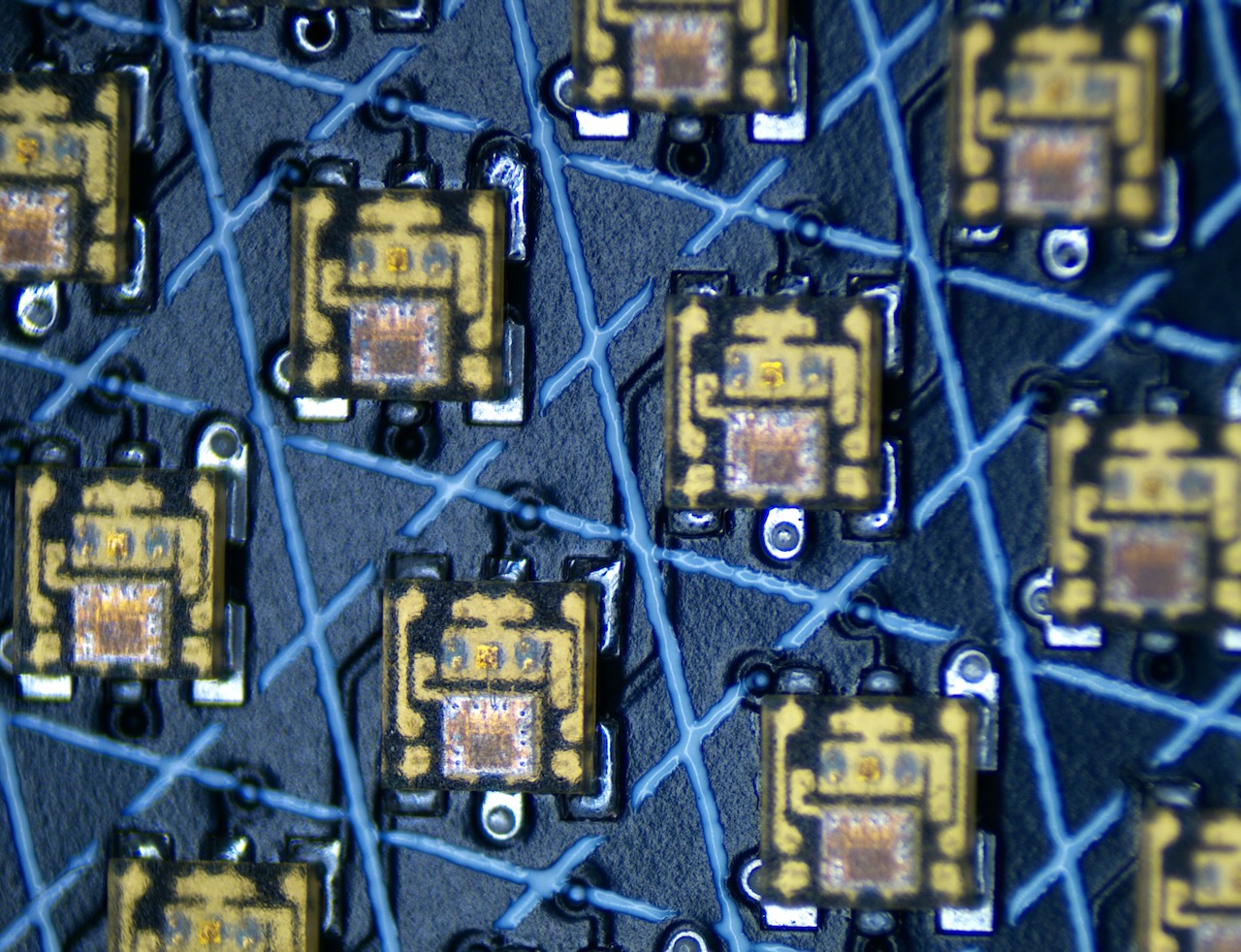
I use python for pixel layout. I went with a zig-zag ordering with all pixels in same orientation. I ended up writing a python type that would let me chain copper-trace draw commands in a compact and flexible way to handle all the routing cases when connecting the pixels. All the pixel and capacitor traces are placed programmatically.
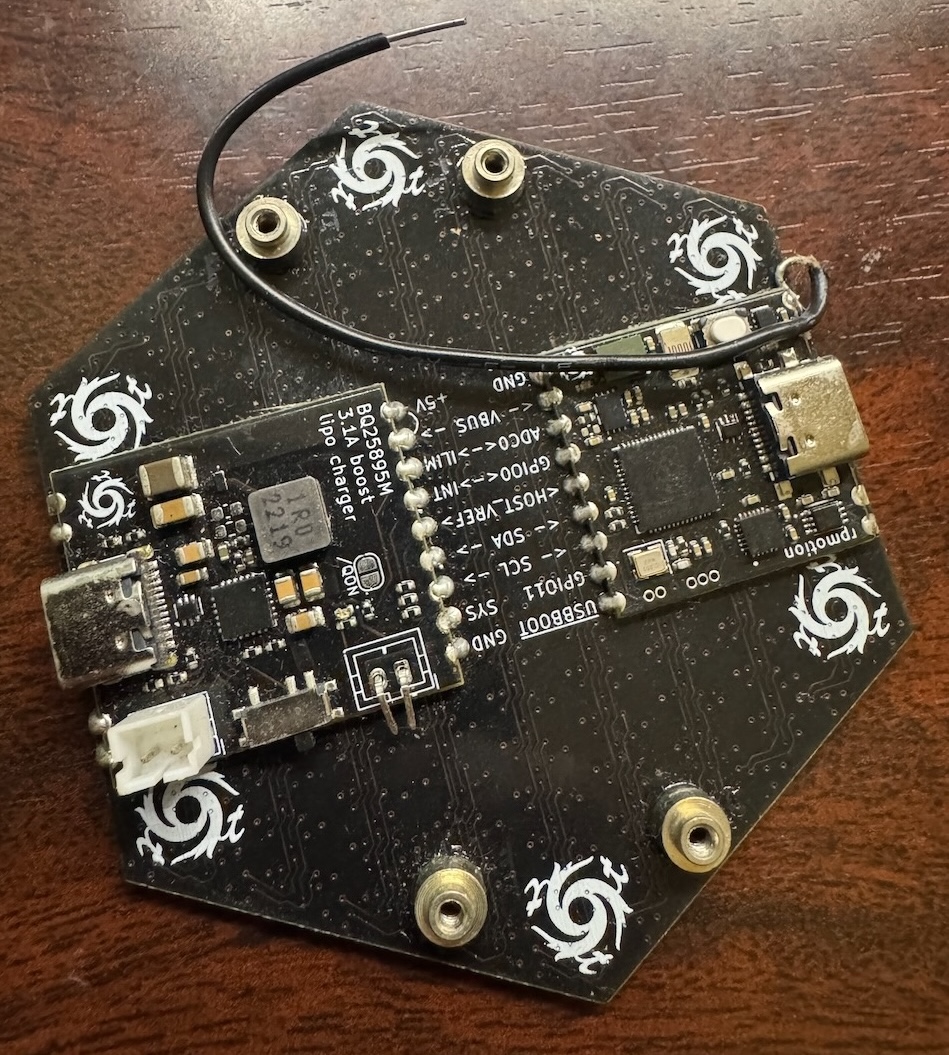
To learn the motion chip and make my first nontrivial rp2040 board, I made a separate castellated logic controller. To learn battery management and boost circuitry, I made a separate castellated power controller. I intended for these to be independently-useful modules, but since the two needed to communicate using pins thru the hexa, this undercut the advantage of modularity. Still, it was good for me to do this practice, since i made mistakes and had to rev both boards anyway.
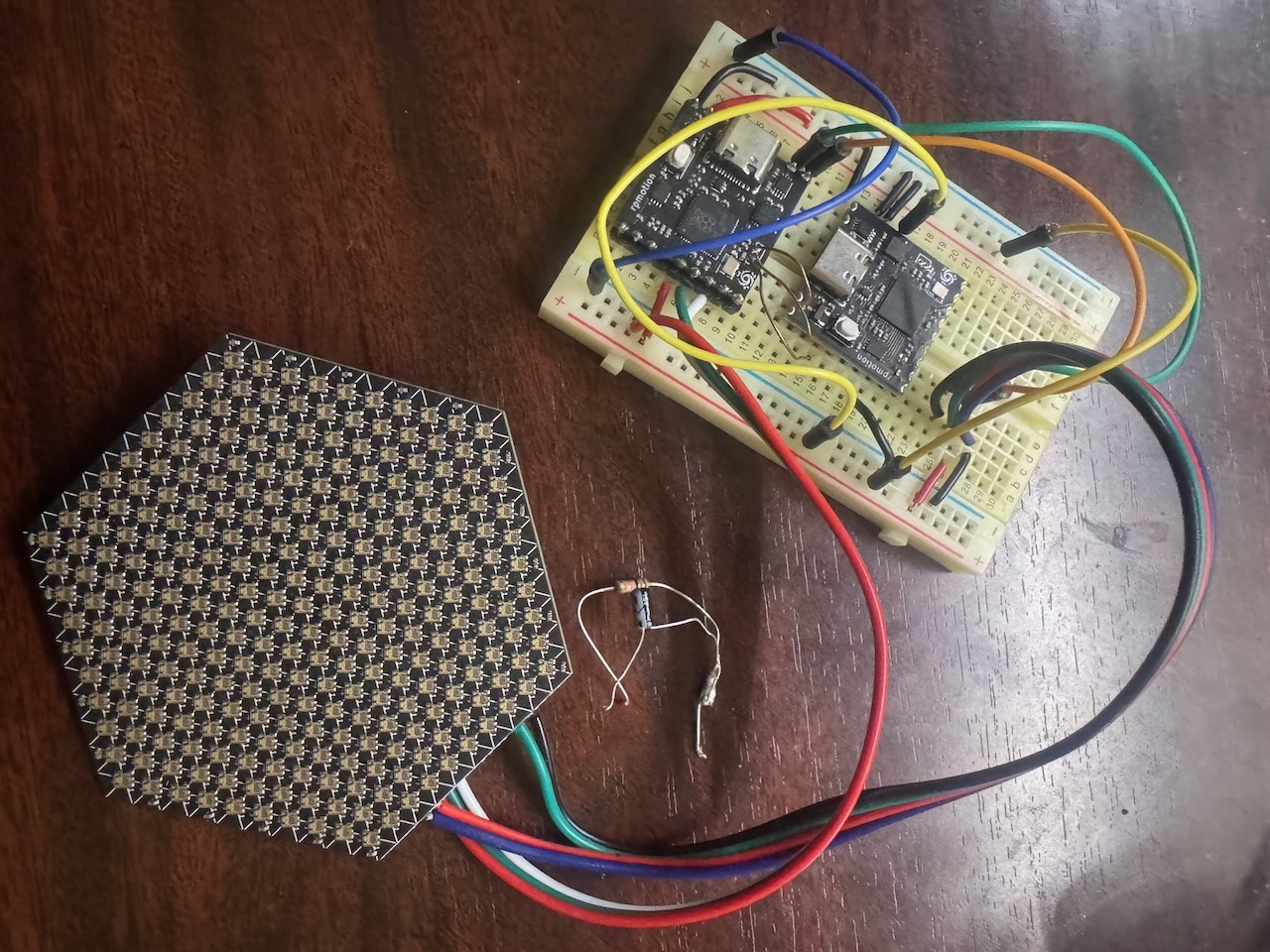
I learned that even though rp2040 says it can run at 1.8V (which is what the motion chip needs) and it can, the USB peripheral does actually need 3.3V. For the first rev, i would use one powered at 3.3V (so no motion chip) and one at 1.8V (no usb) connected over serial-wire debug to make one almost-working motionhexa.
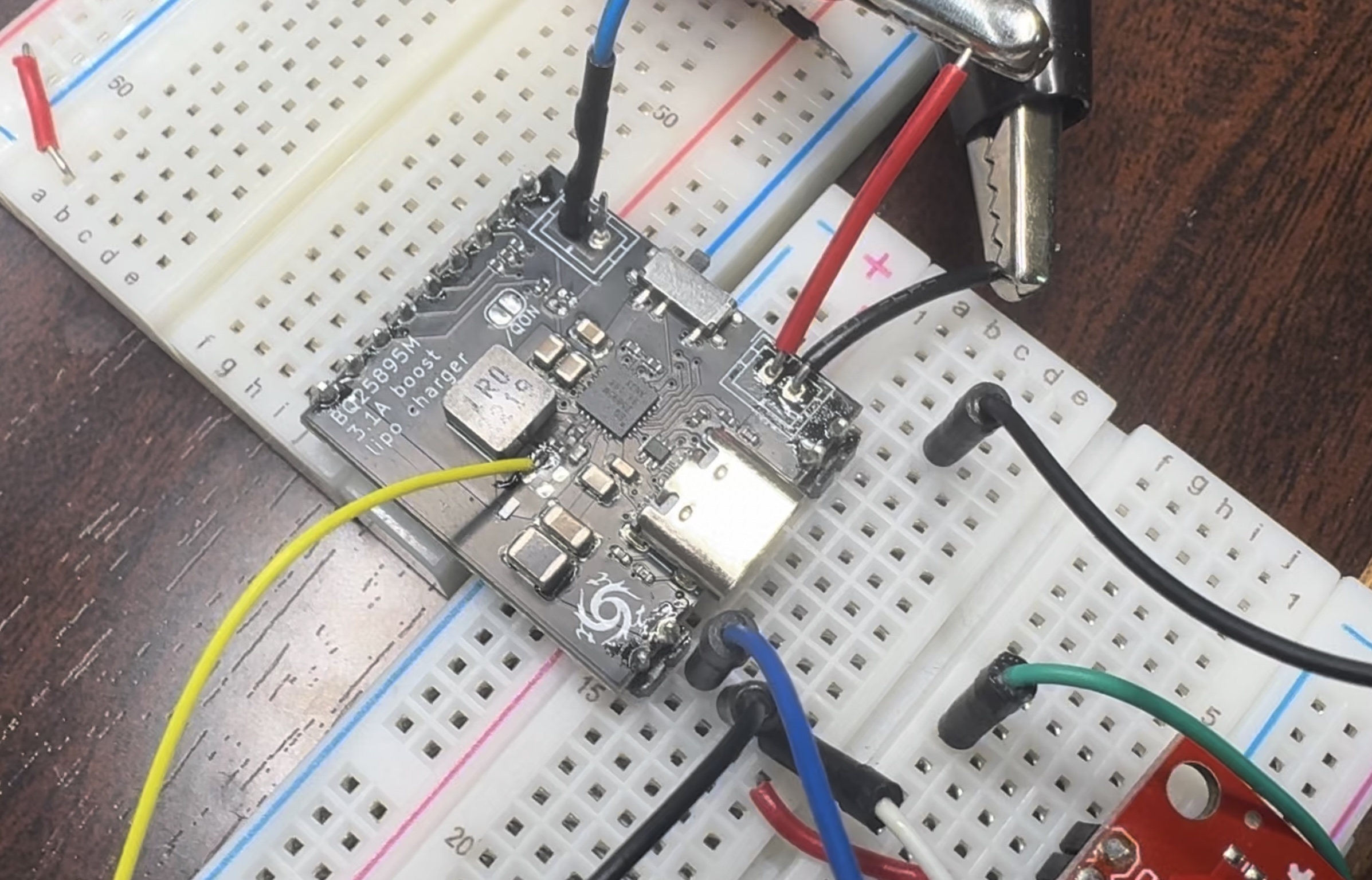
I learned that using an integrated chip like BQ25895M is way overkill for my use case, and though i set out to make it capable of 3.1A boost, my prototype was never capable of that full current, (not that the pixels could handle the thermals anyway). Further, this chip is for charging cell phones I guess, and disabling their "on the go" power output did not actually disconnect the load from the battery, so my power switch didn't work without a bodged-on SOT-23 mosfet.
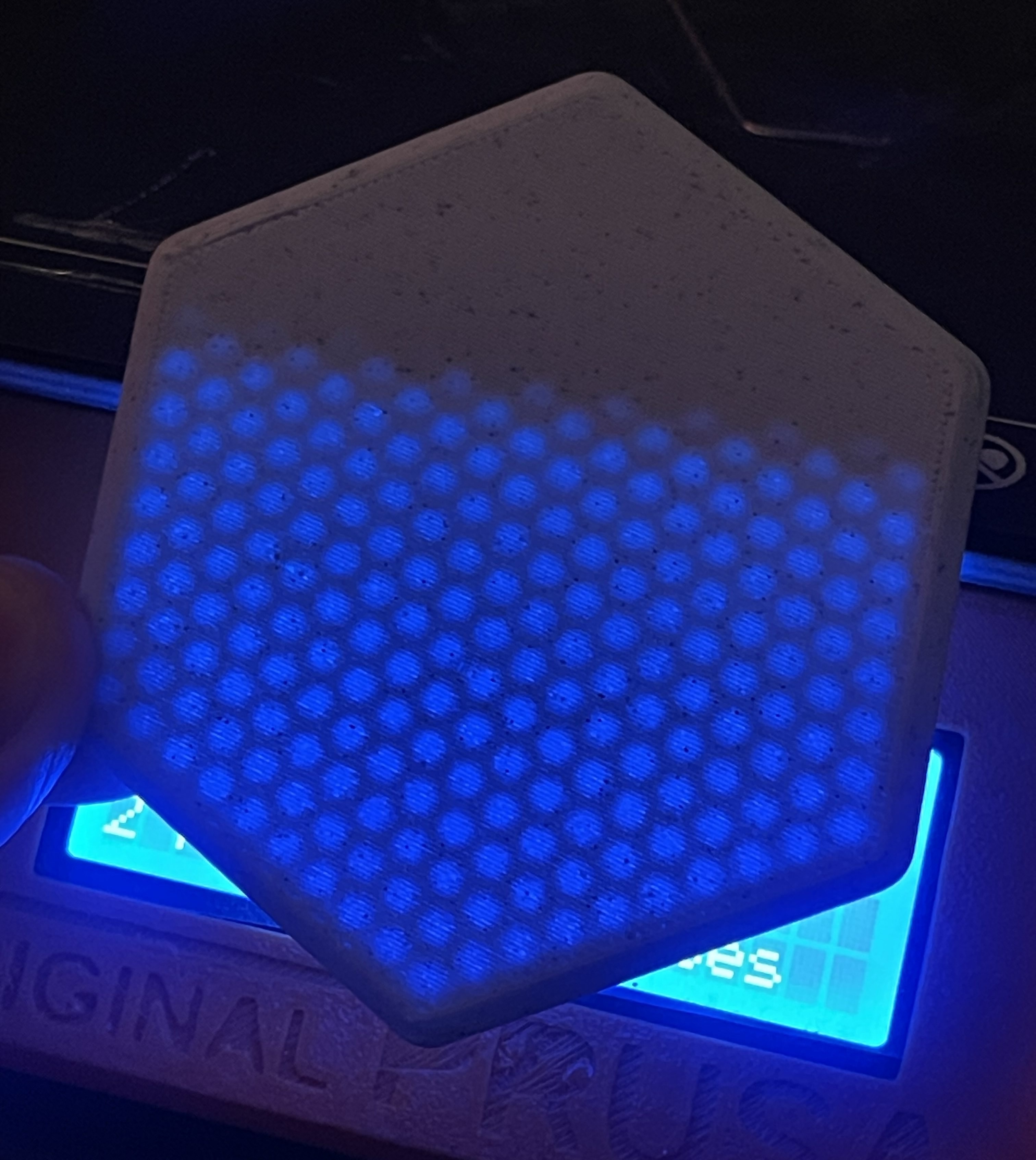
Around this time, @sequoia.farm designed a front-case for hexa with segmented pixel slots and printed in semi-opaque PLA. It snapped onto the pixels pcb and used tiny hexagonal-shaped divots to give the pixels area, which I realized I really liked vs the blur effect you get from led acrylic.
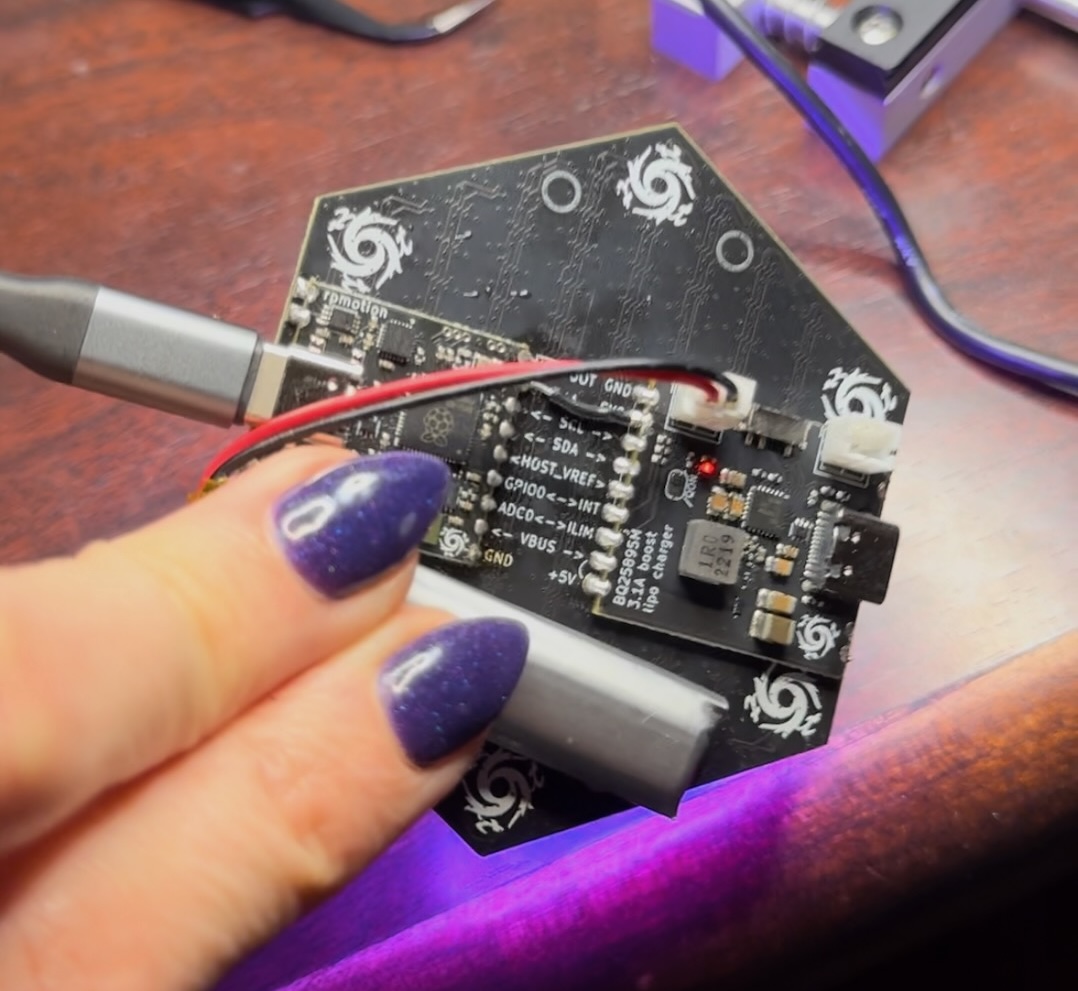
So far, hexa was an interesting prototype and I wrote some pretty and fun lights for it, including the swirling spiral and the pixel physics, but the object itself was awkward and I wasn’t sure what to do with it. It was educational but unsurprisingly tedious and inflexible. I became too familiar with the specifics of when the BQ25895M powers its PMID pin and at what voltages. My power switch was in a terrible location even when a hardware patch got it working at all.
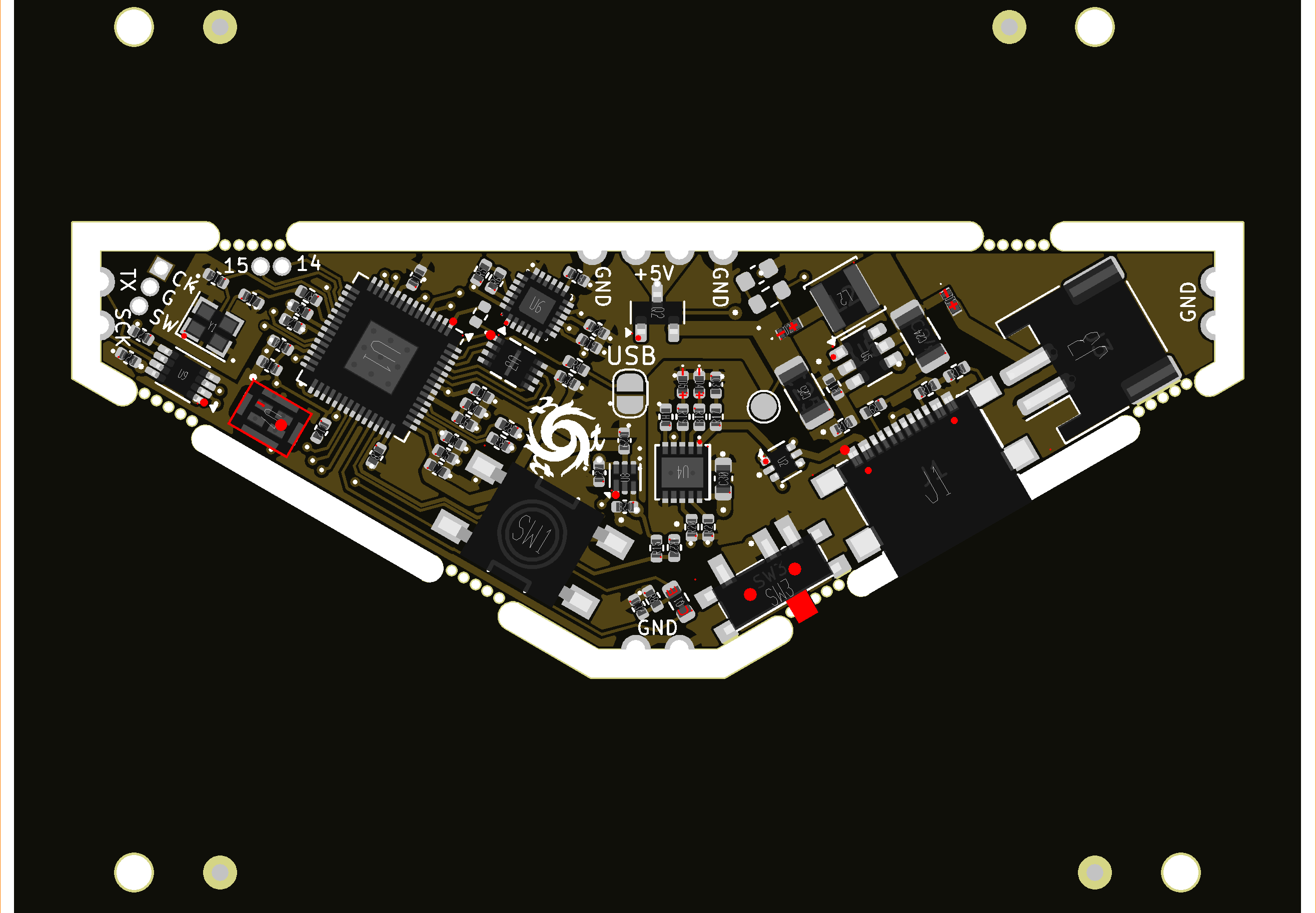
The boards in this position also made it difficult to attach a battery. To resolve this, I started over with the controller and put the logic & power control on a single wedge-shaped pcb, leaving a rectangular space for a large battery. I used an MT3608 for boost and a cheap lipo charger.
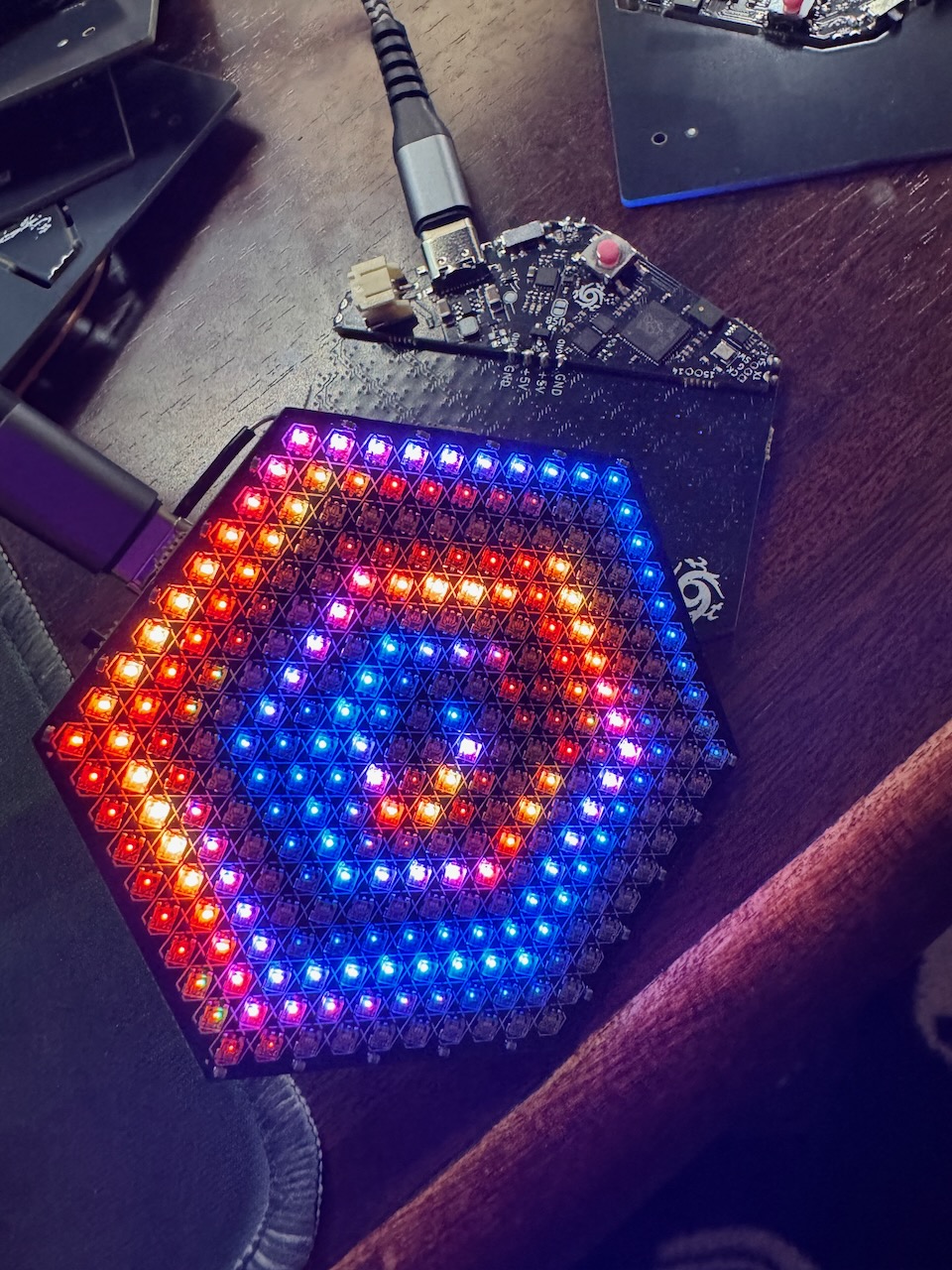
now i was cooking, and it was coming together as a self-contained object. I had so much space for a battery. It needed a back case, it needed more pretty motion-reactive animations.
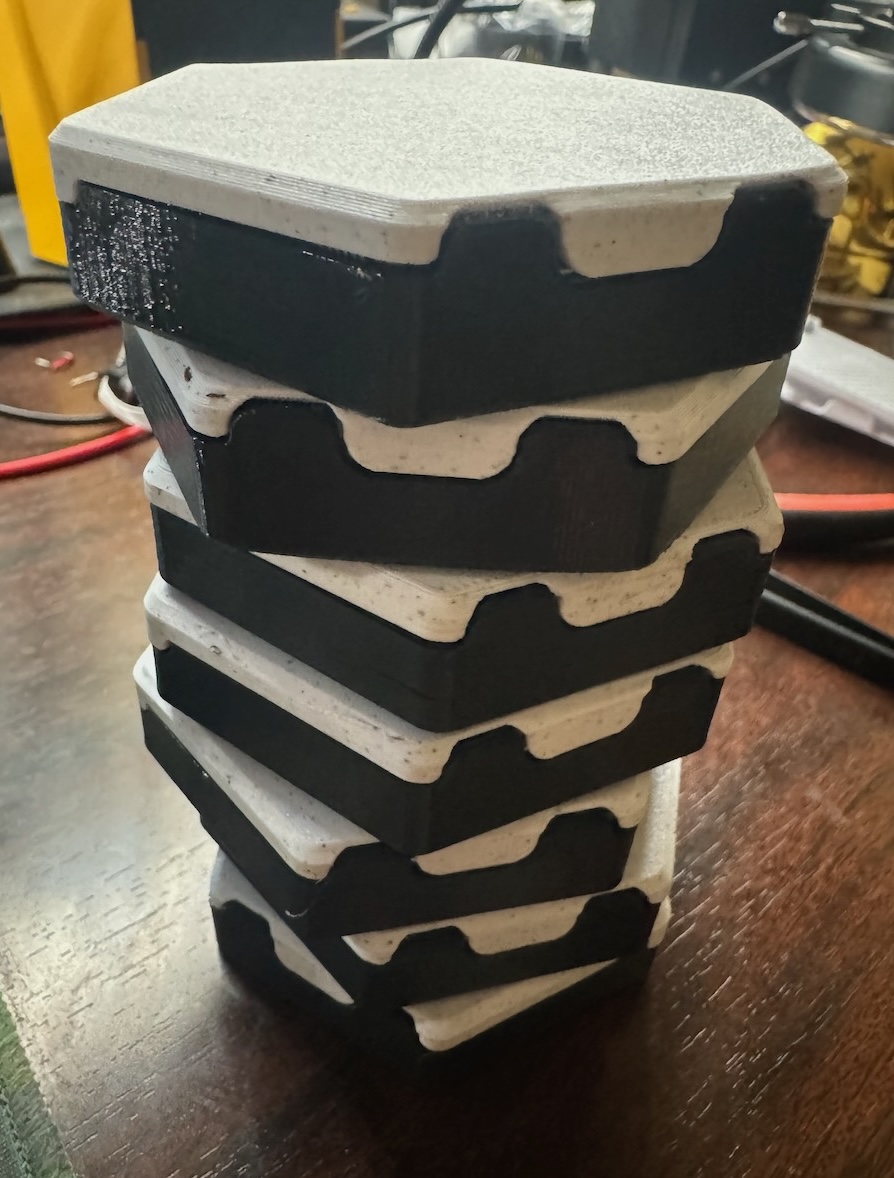
Freshly armed with CAD, I put together a back case to cover the controller and hold in the battery, and the hexa came together into An Hexagonal Object.
For the first form-factor prototypes, I had a power switch and a punch-out affordance for a push button. This worked, but required a lot of hunting for the switch and button since they were hard to find tactilely.
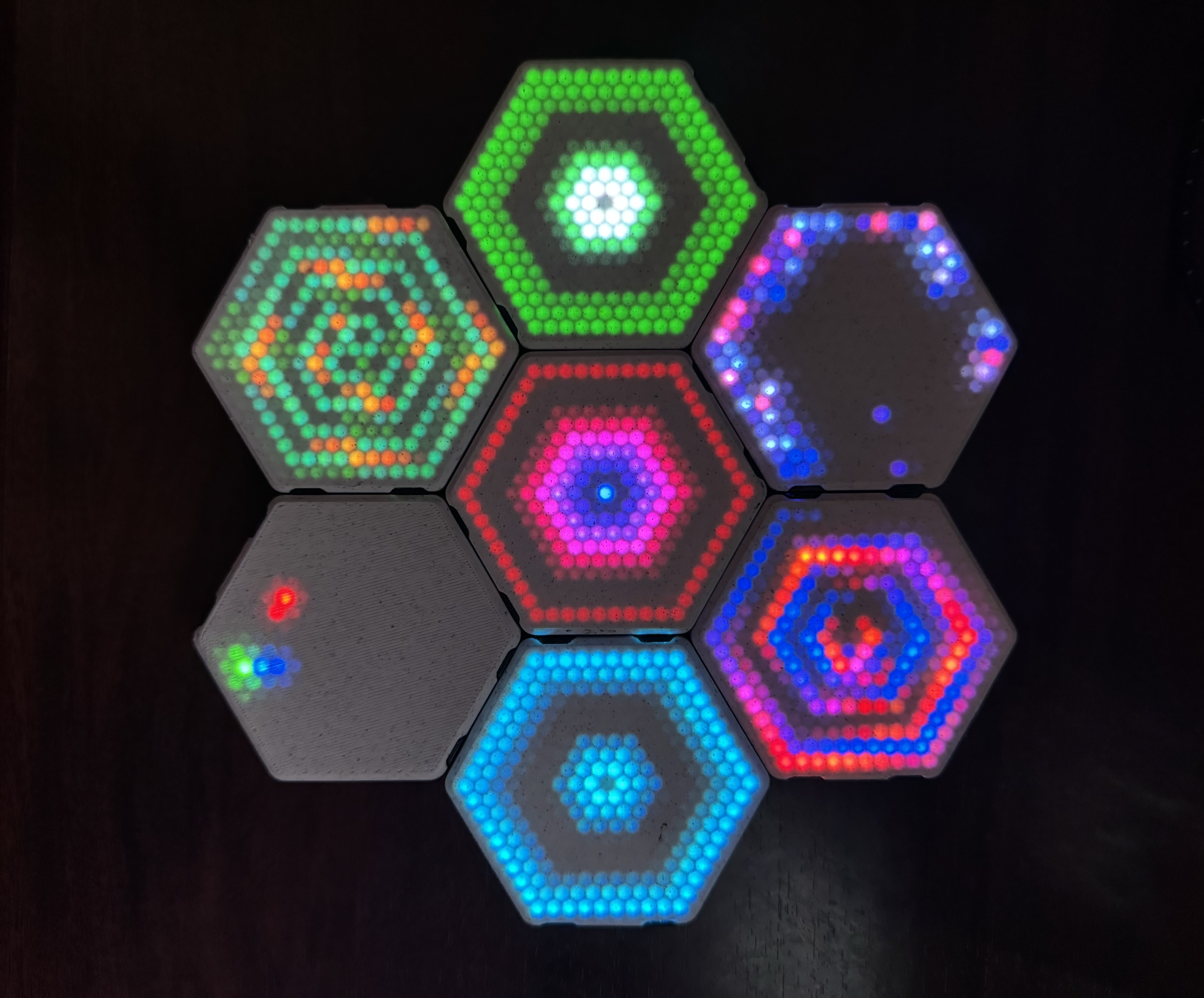
they looked no less gorgeous. chance would have it that i had seven working prototypes, a centered hexagonal number. these seven went with me to a late-spring festival in the forest, bringing so much delight, and showing me where to go with it next
- No tiny flimsy power switch
- A button you could find by feel, or a button that was everywhere
- A way to tell it was charging, ideally on the main pixels
- Lots of polish
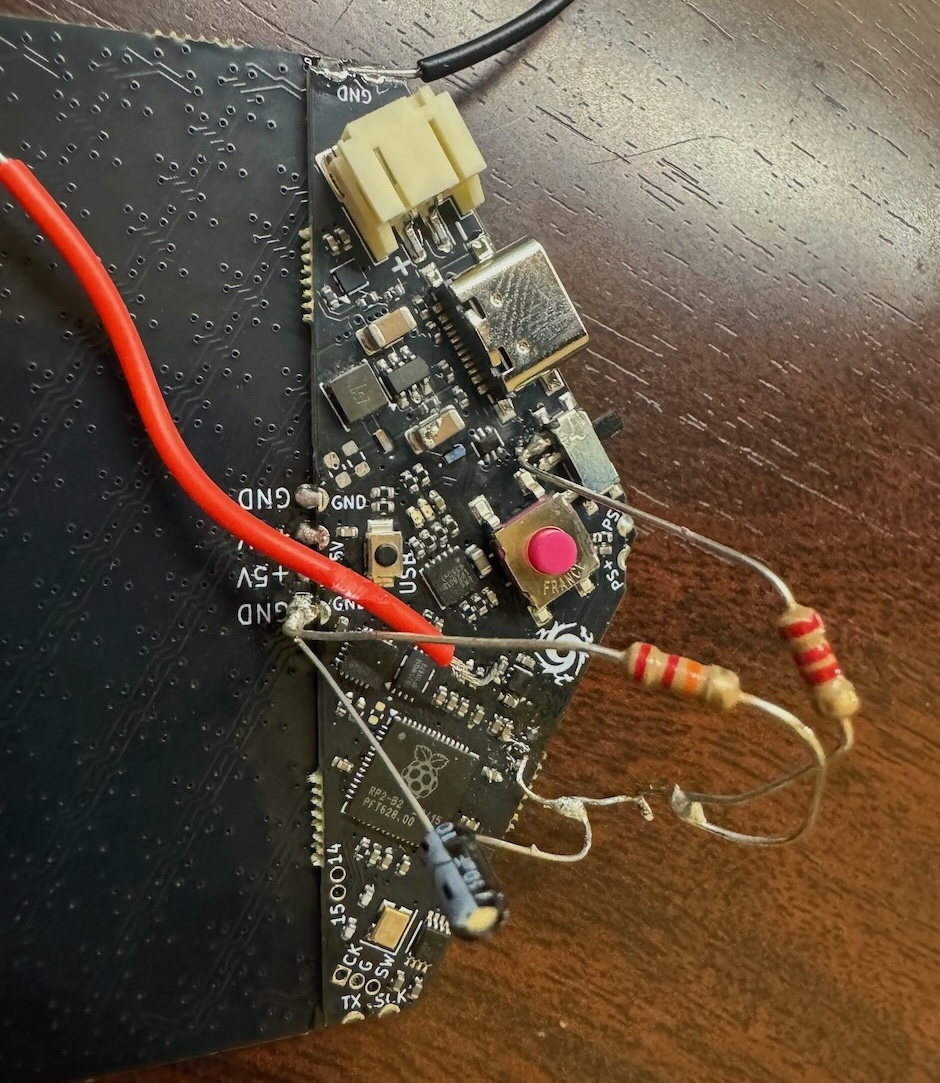
I spent three hardware iterations on the controller over the summer to design a power path that could do power-on-off as well as act as a software button, as well as keep running everything on usb power even if the hexa was “off” so that it could draw a charging ring on the main pixels, and also have the whole thing not fall apart in the absence of a battery. My scope got a lot of use.
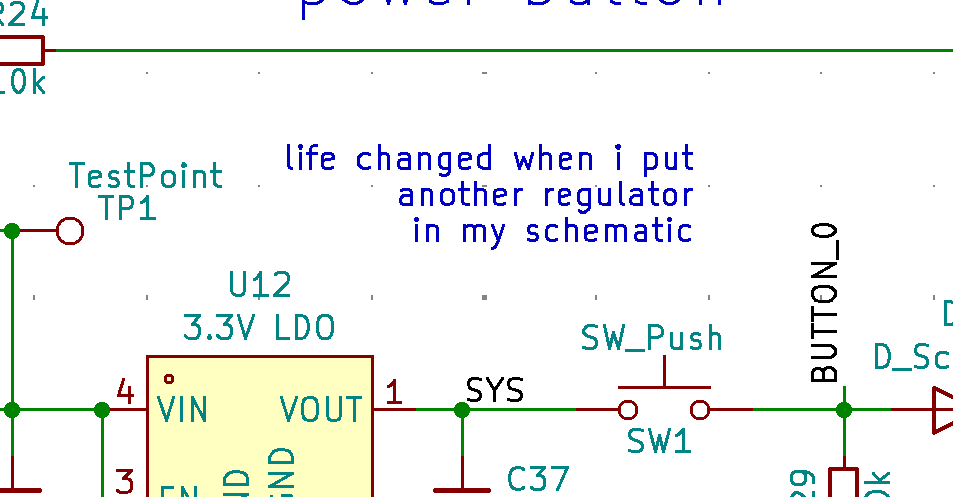
the key learning for me, to avoid ever relying on the lipo charger's output voltage in a button-based power-on circuit, was to use a second, always on linear regulator to unify battery+usb voltage, rather than using a mix of zeners and dividers and other diodes for voltage management, and to use that stable voltage across the button to power the main dual-zone ldo, which powers the rp2040 and sensors.
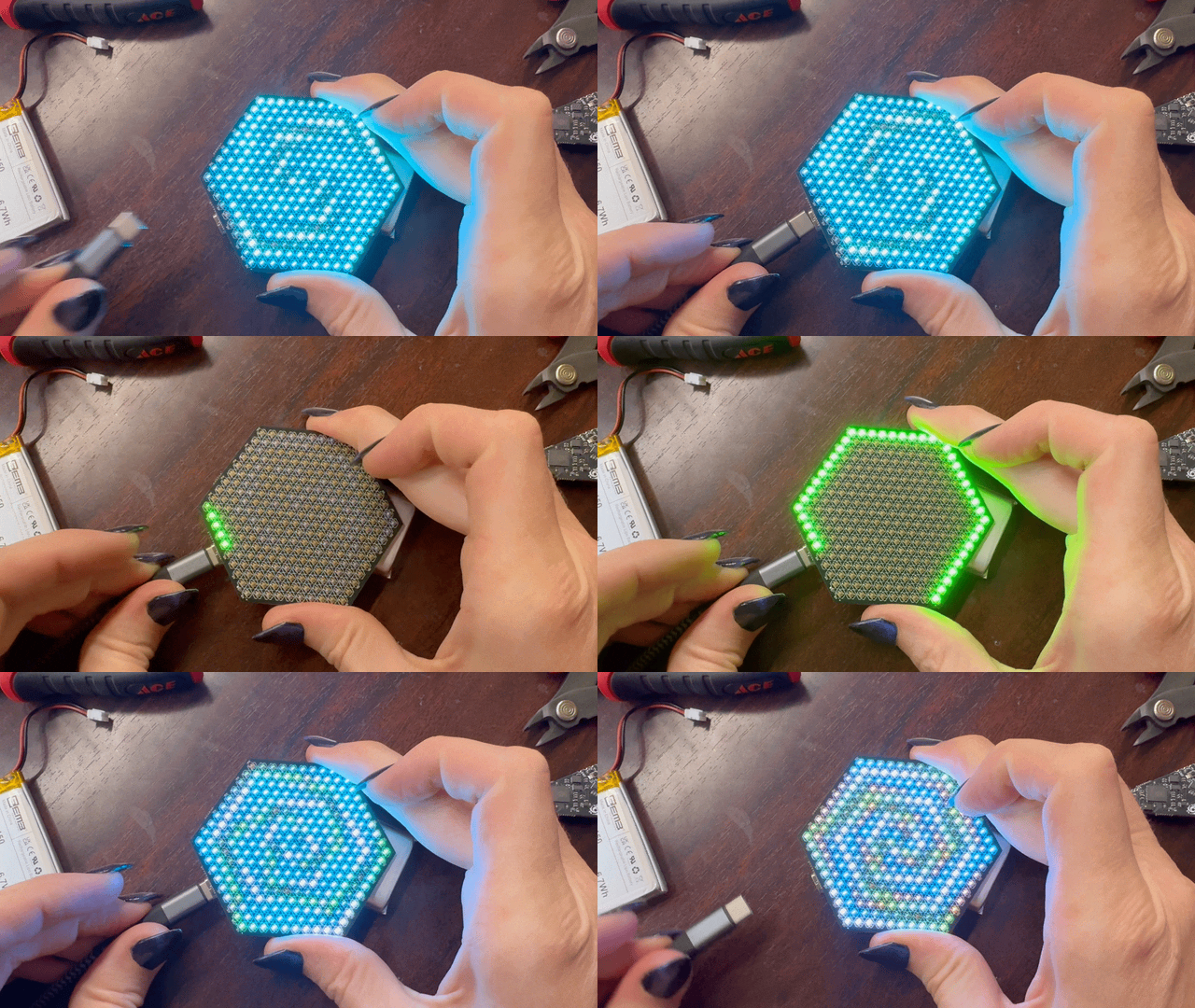
Having finally sorted this out, hexa finally had a polished-feeling charging experience.
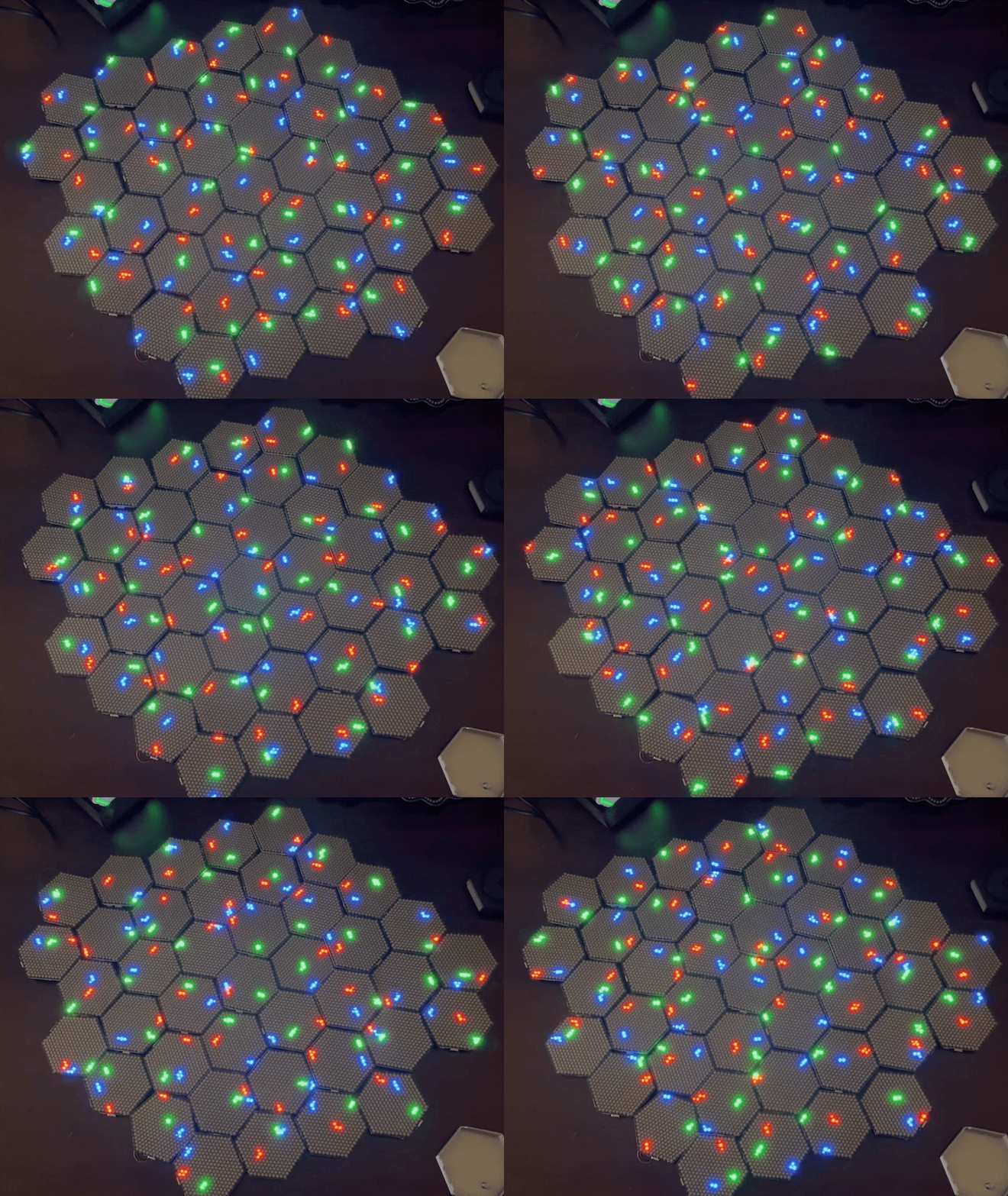
I polished software a lot for Makerfaire, but had just as many things not make it in time. I had an improvement/rewrite of my pixel physics that wasn’t stabilizing yet. I had failed to get my (LinkMems) microphones working at all (I later learned it was due to unusual PDM wire timing). I did not get auto brightness working. I was painfully aware of several bugs.
What we ship is always imperfect.
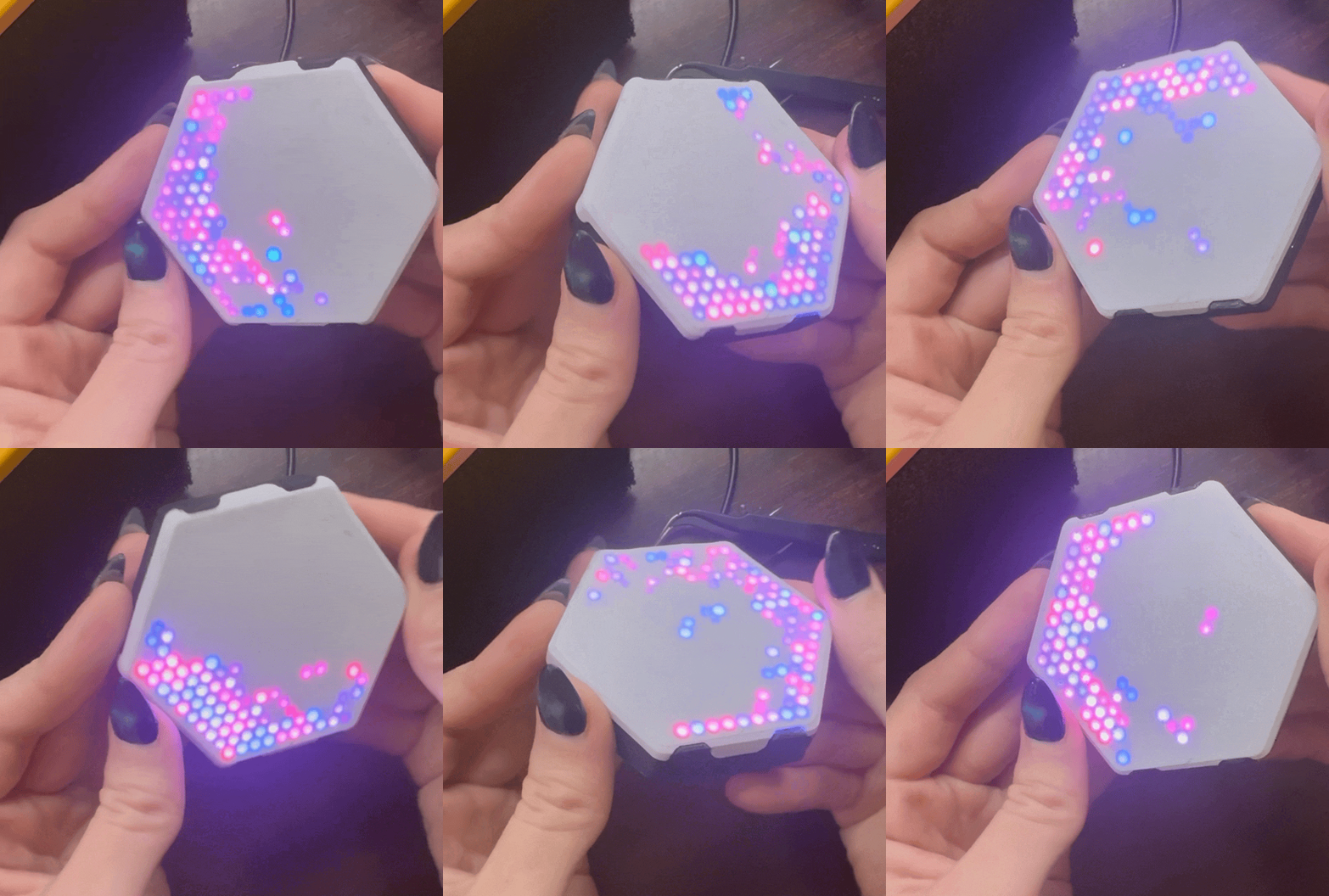
Nevertheless, so many things came together just in time, from working power and charging, to the MJF nylon back cases, and it was such a joy to see people's faces light up when they moved it around and find it moving back. It's such a stim toy that it's hard to put down.
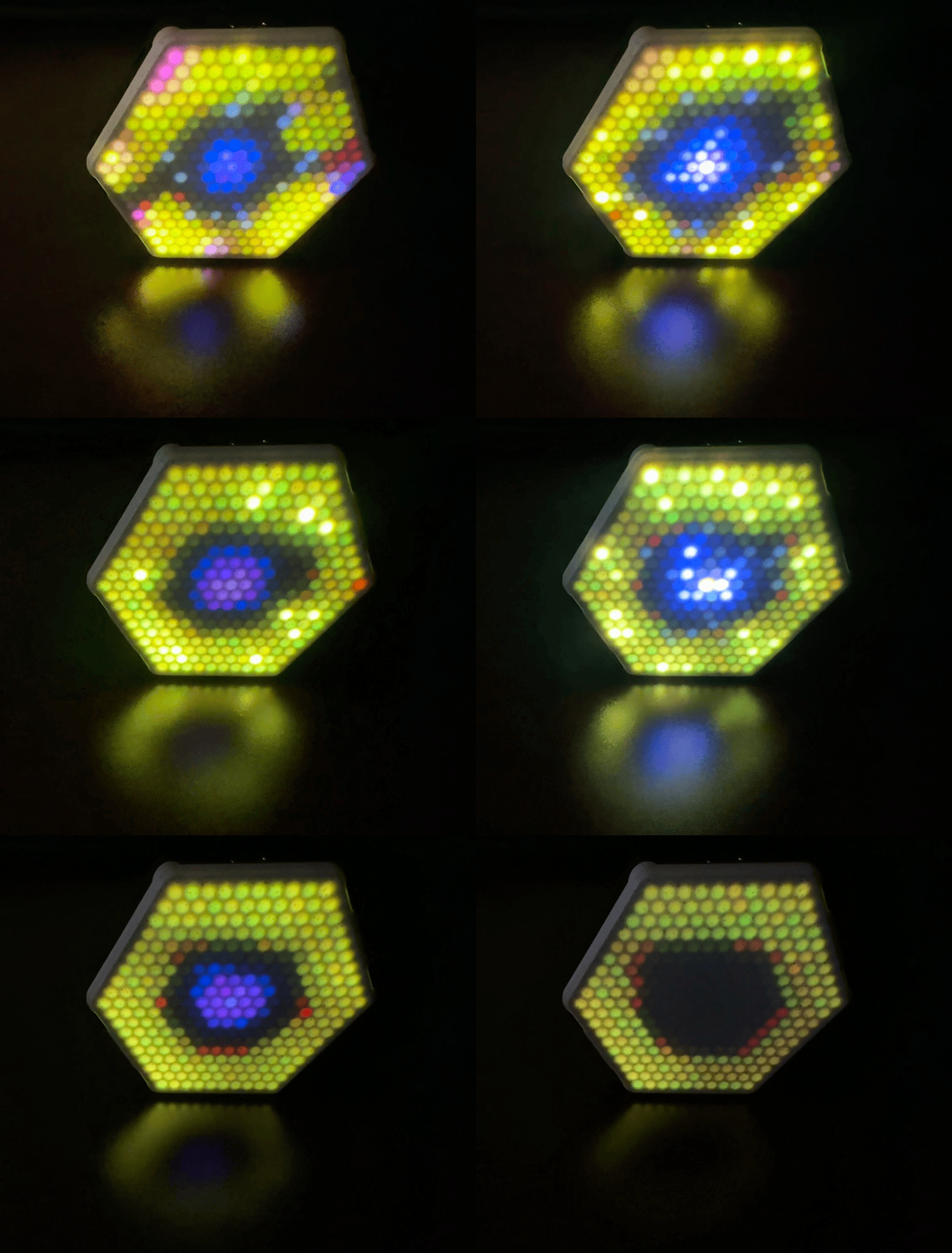
After Makerfaire and sold fresh out of hexagons, I kept iterating and revised the controller to remove the boost circuit, having ironically sorted out that the pixels and power were all working fine at lipo battery voltage. I shrink the controller slightly since the castellated joints were interferring slightly with the case assembly, and a few other small changes. I got the microphone working in software. I am slowly adding spice, variety, delight, easter eggs to various patterns. It remains a work in motion.
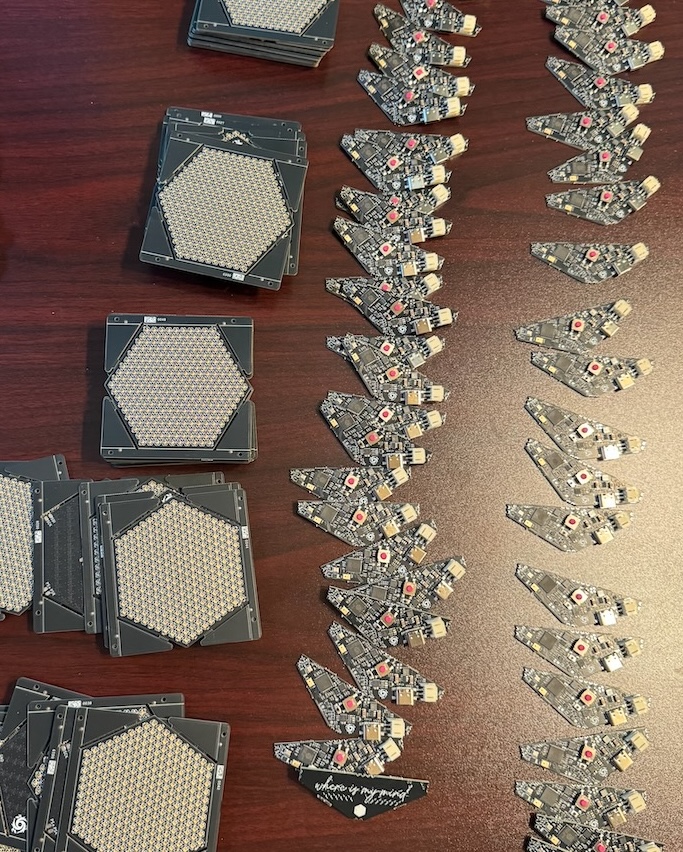
Future: I would like to further refine the hexa by combining the controller and pixels into a single board. This multi-board (3, down to 2) strategy was a good way for me to learn, but it is more expensive to manufacture and requires more hand assembly from me once the boards arrive. It would also make it easer for me to add multiple light sensors to the front of the device to implement more reliable autobrightness. To do this, I will have to re-layout the pixel wiring as well as the controller. and share via space, which is the most challenging part.